
What They Can’t Erase: The Soul of South Dallas
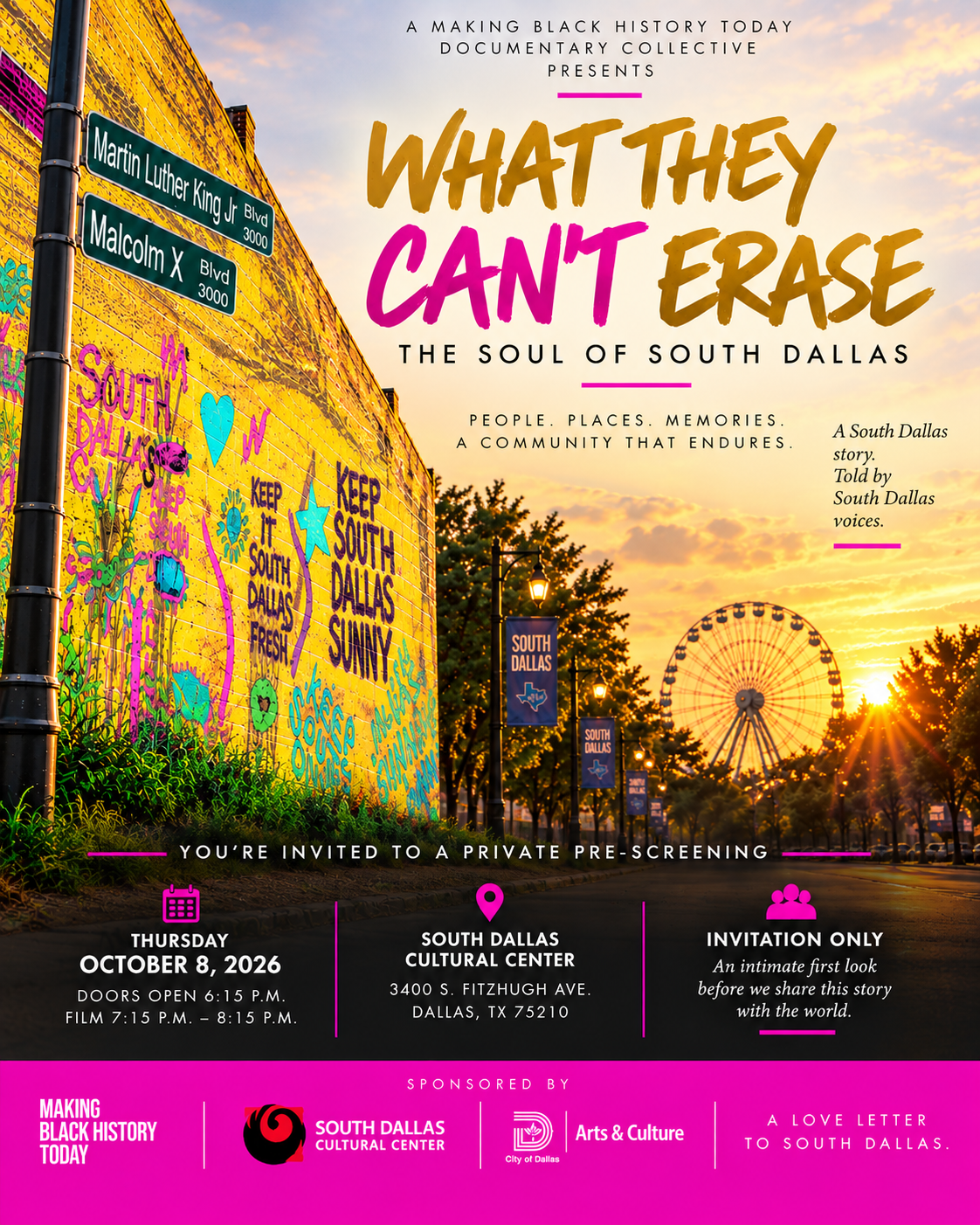
A deeply personal visual love letter to South Dallas and a call to preserve the stories that belong to us.
What They Can’t Erase: The Soul of South Dallas is a deeply personal visual love letter to a historic Black community and the people who have shaped, protected, and carried its story forward.
Written and directed by a first-time filmmaker from South Dallas, the film brings generations together through the voices of elders who remember the community they helped build, leaders and educators who continue shaping its future, and a younger generation learning what it means to inherit that history. Their stories reveal a South Dallas shaped by change, yet sustained by memory, connection, and a deep sense of belonging.
At its heart, the film is a call for generations to preserve their own stories and work together to protect the history that belongs to them. Because history is not simply what we leave behind, it is what we choose to remember, preserve, make, and carry forward every day.
About the film
South Dallas is more than a place. It is a community with a deep historical legacy, shaped by generations of people who built families, institutions, traditions, and a lasting sense of belonging.
What They Can’t Erase: The Soul of South Dallas is rooted in the belief that some of the most important history lives in the memories and voices of the people who experienced it. Through oral history, the film honors elders as keepers of community memory while creating space for younger generations to listen, learn, and carry those stories forward.
The film explores what happens when communities do not preserve their own stories and the responsibility we share to make sure those stories survive.
Rather than focusing solely on what has been lost, the film centers on continuity: what remains, what is being built today, and what each generation has the power to carry into tomorrow.
Because preserving our history is not simply about remembering where we came from. It is making Black history today.
Director’s Statement
From the Director
I grew up in South Dallas. For most of my life, I thought I knew what that meant.
I knew the blocks, the familiar faces, and the places that had been part of our neighborhood for generations. But as I got older, I began to understand that living in a place is not the same as knowing its history and that much of ours was quietly slipping away.
The real shift happened when I stopped just passing by our elders and started truly listening to them. Sitting with them, I realized I was in the presence of an unwritten archive. They remembered the businesses, schools, organizing halls, and cultural traditions that you will never find in a Dallas textbook or city archive. They carried a history that existed almost entirely in living memory.
That realization stayed with me, accompanied by a heavy question: What happens when the people who carry those memories are no longer here to tell them?
That question became this film.
What They Can’t Erase: The Soul of South Dallas is an act of listening, but it is also an act of active preservation. I didn't want to make a documentary simply about what our neighborhood has lost, I needed to capture what remains, what endured, and who is carrying that legacy forward today.
Buildings can be demolished, borders can be redrawn, and commercial landscapes can change overnight. But identity, memory, and generational truth cannot be erased so easily unless we allow them to be forgotten.
This film is my responsibility to the place that made me. I made it because our communities deserve to own their narratives, spoken in our own voices. History isn't just something sitting behind us in the past. Sometimes, it is sitting right beside us, waiting to see what we will do with what we’ve been given.
— LaToya K. Porter
Director, What They Can’t Erase: The Soul of South Dallas
About the Filmmaker
LaToya K. Porter
Civic Entrepreneur | Cultural Strategist | Documentarian
LaToya K. Porter is a Dallas native, documentarian, and first-time filmmaker whose work centers community memory, lived experience, and the people whose stories often exist beyond the public record.
For Porter, What They Can't Erase: The Soul of South Dallas is deeply personal. South Dallas is not simply the setting of the film, it is home. Born and raised in Queen City, Porter grew up among the families, institutions, sacred spaces, and generations of residents whose lives have shaped the community she now documents.
Her approach to filmmaking is informed by an unconventional path to the director's chair. Porter spent years in public service, including leadership as a Dallas police executive, and now works as Chief Investigator at Sbaiti & Company. A career built around investigation has taught her to listen closely, look beyond what is immediately visible, and recognize the distance that can exist between what is officially recorded and what people actually lived.
That same instinct for listening and preservation led Porter to co-create Making Black History Today, an oral history and storytelling platform documenting people shaping Dallas history in real time. Through those conversations, she became increasingly interested in the stories held not only in archives and institutions, but in people's memories, in what families remember, what neighborhoods carry, and what communities pass from one generation to the next.
What They Can't Erase: The Soul of South Dallas marks Porter's directorial debut and brings that practice of listening to the screen. Rather than attempting to tell the story of South Dallas from the outside, Porter turns the camera toward the community that raised her, allowing residents across generations to reflect on what was, what has changed, what remains, and what they hope will endure.
For Porter, documentary filmmaking is an act of preservation, but not nostalgia. It is a way of honoring what came before, understanding what exists now, and ensuring that the people living history have a voice in how that history is remembered.